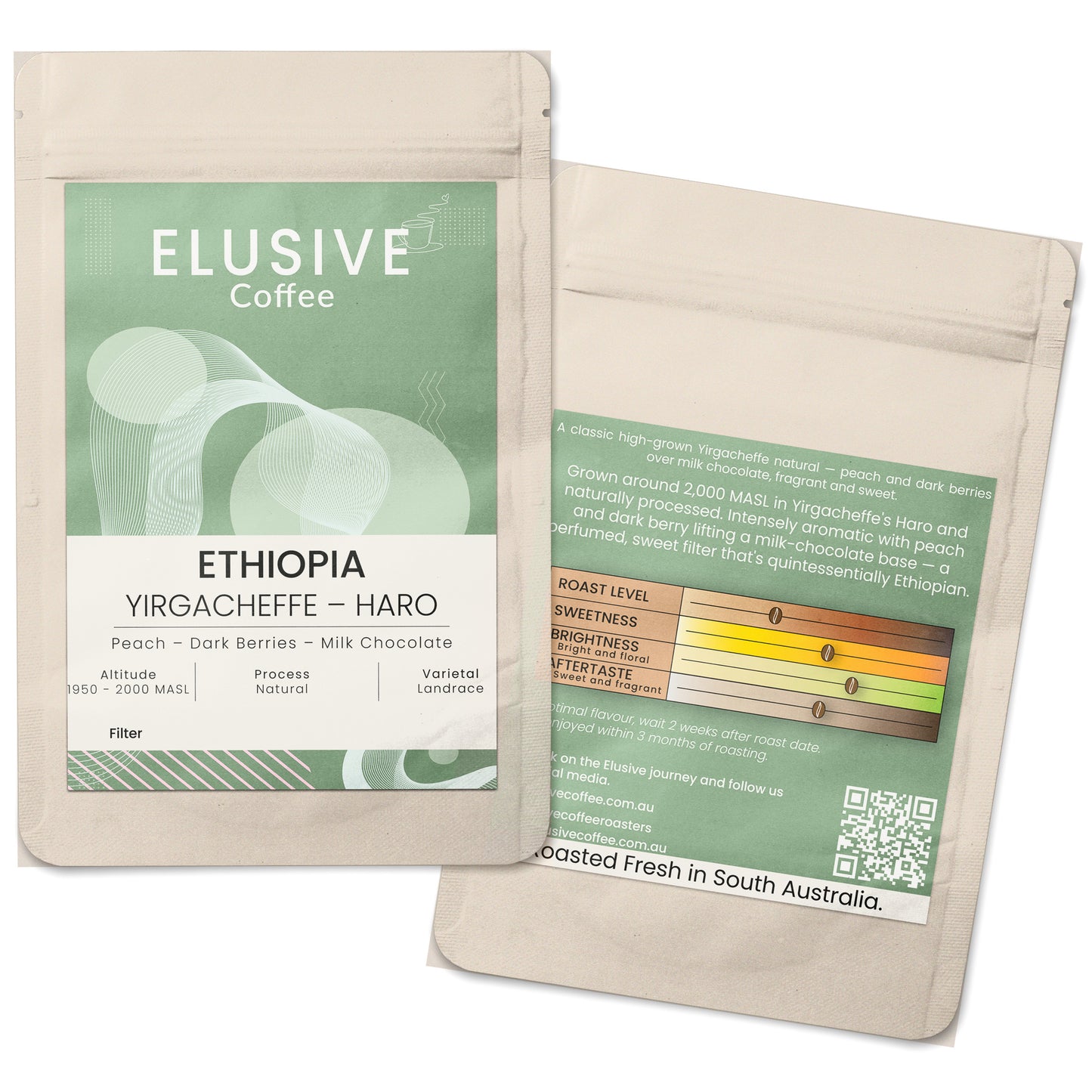

Ethiopia Yirgacheffe Haro is a Grade 1 natural-process single origin coffee from Haroberdame in the Yirgacheffe region of Ethiopia, grown between 1,950 and 2,200 metres and roasted light to order in Adelaide, South Australia by Elusive Coffee. Expect juicy peach and dark berry notes over a silky milk chocolate base with a lingering almond finish — a bright, sweet, fruit-forward cup suited to filter, moka, or espresso.
This bright and polished cup beautifully captures the complexity of Ethiopian highland coffees. Grown at high elevation and dried slowly on raised beds, it delivers vibrant fruit character and exceptional sweetness, with almond carrying through both the aroma and the aftertaste.
We roast it light to bring out its clarity and jammy texture — roasted to order, so every bag leaves our Adelaide roastery fresh.
Free Australia-wide shipping on orders over $60.
Coffee details
- Tasting notes
- PeachDark BerriesMilk Chocolate
- Roast
- Medium-Light
- Best brewed as
- Filter / pour-over
- Process
- Natural
- Altitude
- 1950 - 2000 MASL
- Variety
- Landrace
Brewing guides
Espresso
This light-roasted Ethiopian Yirgacheffe makes a vivid, floral espresso. Light roasts reward a longer ratio: try 1:2.2–1:2.5 (18g in, 40–45g out) at the hotter end of your machine's range, and expect bright citrus and stone-fruit acidity. Beautiful in milk as a sweet, peachy flat white.
Age best used: 14 days after roast. Dose: 18g. Extraction: 40–45g (1:2.2–1:2.5) in 26–34s.
Filter / Pour-over
Filter Coffee Brewing Guide (V60, Chemex, etc.)
Filter coffee offers a clean, smooth, and balanced cup that highlights the subtleties of the beans. Whether you’re using a V60, Chemex, or any other pour-over method, this brewing process allows the coffee’s natural flavors to shine, delivering a lighter yet full-bodied experience.
Brewing Instructions:
- Coffee Dose: 35g of freshly ground coffee.
- Water: 300g of water, heated to around 93°C (200°F).
Pouring Method:
- First Pour: Start with 60g of water for the bloom. Let it sit for around 30-45 seconds to release the gases.
- Second Pour: Add another 60g of water and wait.
- Final Pours: Continue with three pours of 60g each, waiting for the water to draw down between pours.
This 5-pour method ensures even extraction, enhancing the clarity and depth of your brew, while allowing the flavors to fully develop for a perfect cup of filter coffee.
French Press
French Press Brewing Guide
Brewing Instructions:
- Coffee Dose: 30g of freshly ground coffee.
- Water: 450ml of water, heated to around 93°C (200°F).
Brewing Method:
- Grind the Coffee:
Use a coarse grind similar to sea salt. This allows for a slower extraction, which results in a smoother brew. - Preheat the French Press:
Pour hot water into the French Press to warm it up, then discard the water. - Add Coffee:
Place the 30g of ground coffee into the preheated French Press. - Pour the Water:
Slowly add 450ml of water. Stir gently to ensure the grounds are evenly saturated. - Steep:
Place the lid on the French Press, but don’t plunge yet. Let the coffee steep for 4 minutes. - Plunge:
After 4 minutes, press the plunger down slowly and steadily. - Serve:
Immediately pour the brewed coffee into your cup to prevent over-extraction.
Moka Pot
Moka Pot Brewing Guide
Brewing Instructions:
- Coffee Dose: 20g of finely ground coffee (slightly coarser than espresso grind).
- Water: Fill the bottom chamber of the Moka Pot with water, up to the safety valve.
Brewing Method:
- Grind the Coffee:
Use a fine grind, slightly coarser than espresso, for the Moka Pot to avoid over-extraction. - Prepare the Moka Pot:
Fill the bottom chamber with water, just below the safety valve. Insert the filter basket. - Add Coffee:
Fill the filter basket with 20g of ground coffee. Level the surface but do not tamp the coffee down. - Assemble the Moka Pot:
Screw the top and bottom chambers together tightly. - Heat:
Place the Moka Pot on medium heat. As the water heats up, it will create pressure, pushing the water through the coffee grounds into the top chamber. - Watch for the Brew:
When you hear a hissing sound and see coffee filling the top chamber, the brewing process is almost complete. - Remove from Heat:
Once you hear a bubbling sound, remove the Moka Pot from the heat to avoid burning the coffee. - Serve:
Pour the brewed coffee into your cup and enjoy.
Questions & answers
Is the Ethiopia Haro a black coffee or for milk?
Black or filter first — this is a coffee to enjoy for its own flavour. A natural-process Yirgacheffe (landrace varieties, grown high at 1,950–2,000 MASL) roasted medium-light, it has peach, dark berries and milk chocolate notes: fruit-forward, aromatic and sweet. Black as a pour-over it sings; it can take milk thanks to the chocolate note, but you'd be covering up the fruit that makes it special. Reach for this when you want an expressive, fruity cup rather than a classic milky espresso.
What does the Ethiopia Yirgacheffe Haro taste like?
Peach, dark berries and milk chocolate — a fragrant, fruit-forward and sweet cup. As a high-grown natural-process Yirgacheffe, it has the lifted berry-and-stone-fruit character Ethiopian naturals are famous for, balanced by a soft chocolate sweetness from the medium-light roast. It's more aromatic and expressive than our Brazilian or Australian coffees — bright but sweet rather than sharp. A standout for anyone who loves fruity coffee.
How should I brew the Ethiopia Haro?
Pour-over and filter show it best: medium grind, ~1:16, 92–94 °C water, to capture the peach and berry aromatics. It also makes a vibrant, fruit-driven espresso at a gentle extraction (~1:2, 28–32 seconds) if you like brighter shots. Avoid pushing it dark in a Moka pot, which can mute the fruit; a French press works for a fuller, still-fruity cup. Lot-specific recipes are on the product page.